Best for hills and gravel
Best ride-on toys for hills and gravel
A slope is a torque and braking problem. Loose gravel is a tire problem. Neither is the same question as grass, and almost nothing under 24V answers either one.
Written by
Mike M. · owner, Iron Mako Media
Published November 16, 2026 · specs checked against each maker’s current listing
How this page is funded: we earn a commission when you buy through our Amazon links, at no extra cost to you. It does not change which products we pick or what we say about them — the scoring rubric is published and applied the same way to every product. Full disclosure.
Price checked November 18, 2026
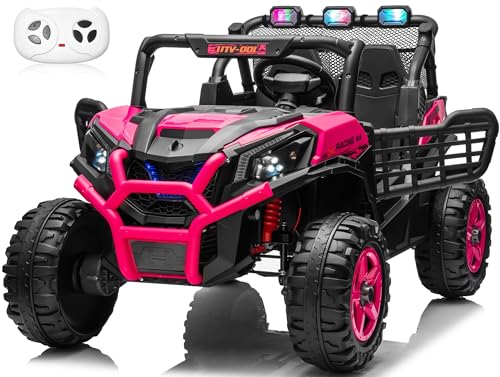
Top pick · Best overall
JOYRACER 24V 4x4 Off-Road UTV 2-Seater
9.6 / 10 on our rubric
All four specs that matter off-road are published: 5 mph, 130 lb, a 20-inch seat and a 3-8 year range.
$299.99 list — 10% off
#ad · Price as of November 18, 2026 · how this is funded
Verdict first
Quick picks
A slope is a torque and braking problem. Loose gravel is a tire problem. Neither is the same question as grass, and almost nothing under 24V answers either one.. Tap any row to jump to that model’s full write-up below, or go straight to Amazon from the price column. Prices last checked November 18, 2026.
| # | Product | Best for | Score | Price |
|---|---|---|---|---|
| 1 | JOYRACER 24V 4x4 Off-Road UTV 2-Seater Best overall | 3-8 years, off-road UTV | 9.6out of 10 | $269.99on the JOYRACER 24V 4x4 Off-Road UTV 2-Seater #ad disclosure |
| 2 | 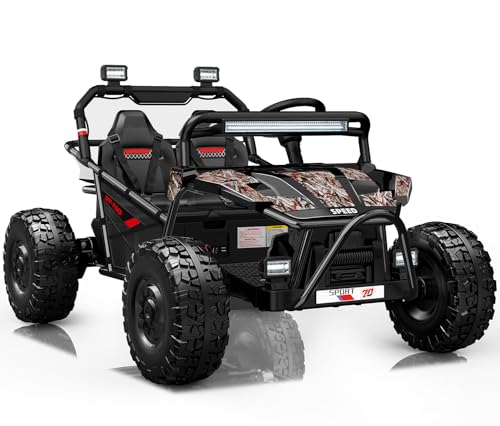 First Ride On 36V 2-Seater Kids UTV Best for steep ground | Age 6+, true driving UTV | 9.2out of 10 | $469.99on the First Ride On 36V 2-Seater Kids UTV #ad disclosure |
| 3 | 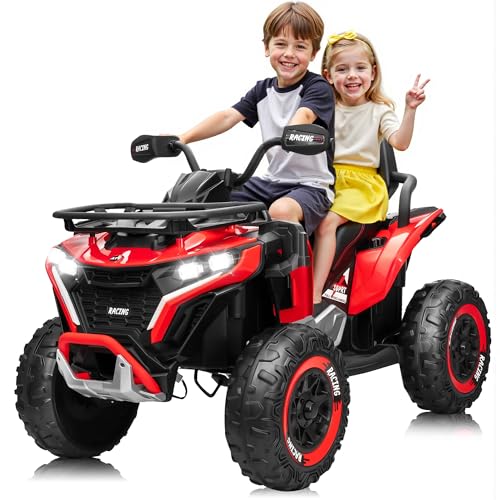 JOYRACER 24V Kids ATV XL Four Wheeler 2-Seater Best for big kids | 3-8 years, two-seat quad | 9.3out of 10 | $319.99on the JOYRACER 24V Kids ATV XL Four Wheeler #ad disclosure |
| 4 | 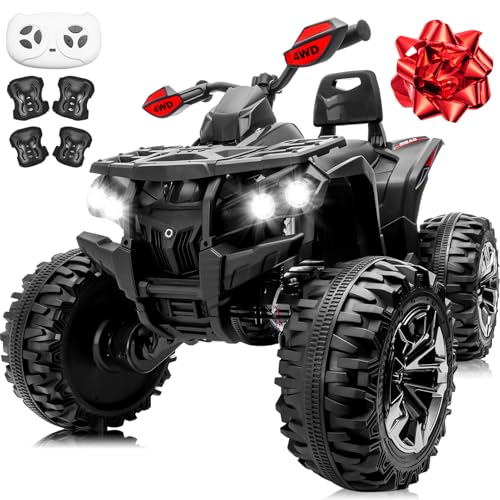 MOEYURO 24V 4x4 Kids ATV Four Wheeler Longest run time | Big kids, largest 24V battery | 9.2out of 10 | $309.99on the MOEYURO 24V 4x4 Kids ATV Four Wheeler #ad disclosure |
| 5 | 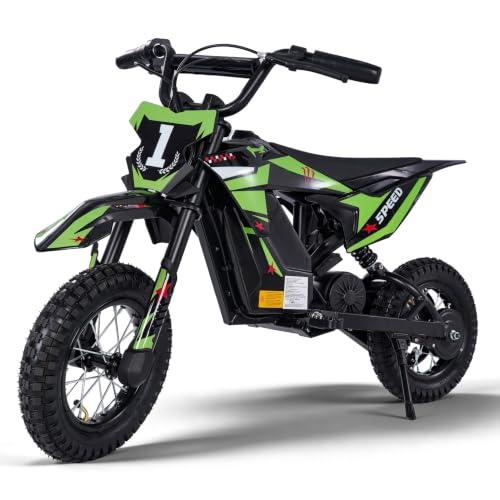 Firstness 36V Electric Dirt Bike Best for trails | 5-10 years, complete spec sheet | 9.4out of 10 | $289.99on the Firstness 36V Electric Dirt Bike #ad disclosure |
| 6 | 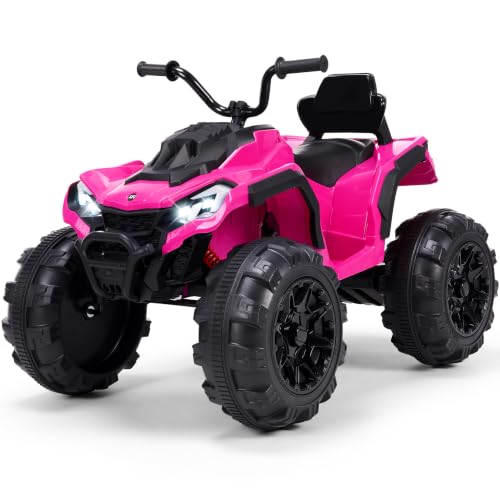 Best Choice Products 24V Kids Electric Ride-On ATV Best on gravel | 3-6 years, suspension and traction | 8.8out of 10 | $279.99on the Best Choice Products 24V Kids Electric #ad disclosure |
| 7 | 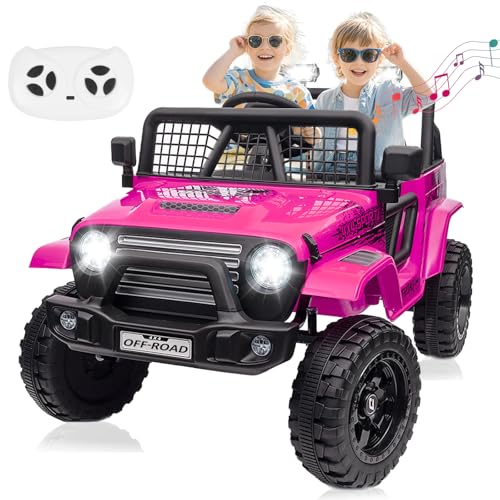 BLISSRIDE 24V 2-Seater Kids Electric Car Budget pick | 3-8 years, budget 24V two-seater | 9.3out of 10 | $186.99on the BLISSRIDE 24V 2-Seater Kids Electric Car #ad disclosure |
Scores are our own editorial ratings on our published 8.4–9.8 scale, explained on how we pick. They are not customer ratings and they are not Amazon’s.
“Will it go up my driveway?” is one of the most common questions in this category and one of the least well answered, because almost no manufacturer publishes a gradient figure. None of the vehicles on this page states a maximum slope, and we are not going to invent one. What makers do publish is motor count, motor wattage, drive layout, tire material, suspension type and weight limit, and those five together tell you most of what you need.
It is also worth separating the two problems in the title, because buyers tend to merge them. A hill is a power-and-braking problem: you need enough torque to keep moving up it and enough control to come down it without the vehicle running away. Gravel, sand and packed dirt are traction problems: hard plastic wheels skate on loose surfaces, and the fix is a tire material that deforms around the stones rather than skidding over them. A vehicle can be good at one and poor at the other.
Method
The five specs that decide whether it climbs
- Drive layout and motor count. Four driven wheels beat two on a loose slope, because a gradient unloads the front axle and a rear-drive ride-on spins exactly the wheels it needs. Four of the seven picks here state 4WD. The two that do not — the 36V UTV and the coil-over quad — earn their place on raw motor wattage, tire material and suspension instead.
- Published motor wattage. Four 200W motors is 800W of claimed drive; two 25W motors is 50W. Both get called “powerful”. The number is the only part worth reading, and roughly half of the listings in this category print one.
- Tire material. Hard plastic is the default and it is the wrong surface for gravel. EVA foam or rubber deforms, grips and runs quieter. Our rubber versus plastic comparison covers the trade-offs, including the fact that EVA wears faster on concrete.
- Suspension type. Rear springs are common. Coil-overs at both ends, or hydraulic forks on a bike, are what keep the driven wheels in contact with uneven ground — which is a traction feature as much as a comfort one.
- A brake you can name. Most ride-ons stop by cutting power and letting the gearboxes drag. On a descent that is not enough. An electronic brake or a variable throttle is the difference between control and a runaway — and exactly one vehicle on this page publishes either, which tells you how rare the specification is rather than how picky we are being.
Voltage
Why 24V is the floor, and when 36V is worth it
A 12V vehicle with two small motors manages a driveway apron and a gentle camber. It does not manage a lawn that slopes, and it certainly does not manage gravel on a slope, because the two problems compound: the wheels that are spinning are also the wheels carrying less weight. Every vehicle on this page is 24V or 36V for that reason, and the cheapest of them is still well above the price of a capable flat-ground 12V car.
36V is worth the step up in two cases. The first is weight: a heavier or older child on a slope needs the torque, and both 36V vehicles here publish limits above 130 lb. The second is control: the 36V UTV is the only vehicle in our registry that publishes a variable throttle and an electronic brake, which is exactly the specification a descent asks for. The trade is that its listing is equally explicit that it has no parent remote at all, by design — so it suits an enclosed property and an older child, not a first vehicle. Voltage explained sets out what each class does and does not do, and 12V versus 24V covers the step most families actually face.
Gravel
What loose ground does to a plastic wheel
Hard plastic wheels have two problems on gravel. The first is grip: the contact patch is small and rigid, so the wheel rides over the top of loose stones and spins instead of biting. The second is wear — sharp gravel scuffs molded plastic tread flat over a season, which quietly turns a vehicle that was adequate into one that is not.
EVA foam tires, which appear on three picks here, deform around the stones and recover, and they run far quieter on a gravel drive. The honest trade-off is that EVA wears faster than plastic on abrasive concrete and cannot be patched. Rubber sits in between on both counts. If your ground is loose, pick a vehicle that ships with EVA or rubber rather than planning to retrofit — though a retrofit is possible on some models, which rubber tire upgrades covers.
A vehicle built for gravel is usually also the right vehicle for a lawn, but the reverse is not true: the picks on our grass roundup are chosen for traction on a soft, even surface, which is a lower bar. If your yard is both, buy from this page.
Run time
Climbing is expensive, measured in amp-hours
A ride-on working against a gradient draws far more current than one cruising a flat driveway, and the practical effect is that every published run time on this page assumes flat ground. No maker publishes a figure for sloped use, so we are not going to put a number on it — but expect meaningfully less than the sheet says. That is physics rather than a defect, and it is the reason capacity belongs on this page.
Three picks here carry 9Ah packs, roughly 30% more than the 7Ah that is standard at 24V. That is not the largest capacity in our registry — a 36V dirt bike reaches 15Ah — but it is the most you will find on a 24V four-wheeler. Where the maker publishes a charge time alongside it, 8 to 12 hours, you can at least plan around it. Run time and charging does the arithmetic, and 24V replacement batteries covers a second pack, which is the cheapest real upgrade for a hilly property.
Who it suits
Matching the vehicle to the ground and the child
For a yard with a gentle, even slope and a cut lawn, the budget 4x4 two-seater at the bottom of this page is enough, and it leaves money for a second battery. For a genuinely steep driveway or a property with loose gravel, the 4 x 200W vehicles are the ones to look at, and the quad layout is the better choice if the child is at the top of their weight band. For an older child on dirt or trails, the 36V bike is a different kind of vehicle altogether — faster, more demanding, and the only thing here that handles ruts properly.
Check the weight limit against the child before anything else, because a slope punishes an overloaded vehicle first. Weight limits explains how the published figures relate to real children, and the UTV roundup, kids ATVs and kids dirt bikes cover each body style in full.
Every pick in full
The picks, in detail
Each entry below carries the same nine specifications, taken from that model’s own current listing. Rows reading not stated by maker are specs the manufacturer does not publish — we show the gap rather than filling it in.
#1 · Best overall
9.6 / 10 · Category-defining
JOYRACER 24V 4x4 Off-Road UTV 2-Seater
JOYRACER
$299.99 list — 10% off
#ad · Price as of November 18, 2026 · how this is funded
All four specs that matter off-road are published: 5 mph, 130 lb, a 20-inch seat and a 3-8 year range.
True 4WD with four 200W motors and EVA tires, a 130 lb limit and 5 mph, with eight of nine specs published. The combination of four driven wheels and a tire that deforms is what gets a ride-on up a slope and across gravel.
The nine specs — maker-stated
Source: the manufacturer's own published specifications on the current Amazon listing.
Why we picked it
- Eight of nine specs published
- 4WD with 4 x 200W motors — real grass capability
- 130 lb limit and a 20-inch seat
- 5 mph with a 3-8 year range stated together
Scores strongest on
Traction · Power · Spec disclosure
Good to know
Charge time not published
#2 · Best for steep ground
9.2 / 10 · Outstanding
First Ride On 36V 2-Seater Kids UTV
First Ride On
#ad · Price as of November 18, 2026 · how this is funded
36V, 14-inch EVA wheels, a metal chassis and a deliberate no-remote design — a true driving UTV for a six-year-old and up.
36V, 14-inch EVA tires, a reinforced metal chassis, rear spring suspension and a variable throttle with an electronic brake. The brake is the part that matters on a descent, and it is the spec nearly every rival leaves out.
The nine specs — maker-stated
Source: the manufacturer's own published specifications on the current Amazon listing.
Why we picked it
- 14-inch EVA tires, reinforced metal chassis and rear spring suspension
- 36V 9Ah with 2 x 200W motors
- Variable throttle and electronic brake — real vehicle control
- 3-point belt on each of two seats
Scores strongest on
Power · Traction · Safety
Good to know
No remote at all — the listing is explicit that this is intentional
#3 · Best for big kids
9.3 / 10 · Outstanding
JOYRACER 24V Kids ATV XL Four Wheeler 2-Seater
JOYRACER
#ad · Price as of November 18, 2026 · how this is funded
A 9Ah pack, EVA tires and a 135 lb limit on a two-seat quad — the most capable quad in the registry on paper.
All nine specs published, a 9Ah pack behind four 200W motors, a 135 lb limit and a 3.1-5.9 mph band. The quad layout puts the rider's weight over the driven wheels, which is why quads climb better than cars at the same power.
The nine specs — maker-stated
Source: the manufacturer's own published specifications on the current Amazon listing.
Why we picked it
- All nine specs published
- 9Ah pack and 4 x 200W motors
- 135 lb limit with a 19-inch seat
- EVA tires rather than hard plastic
Scores strongest on
Spec disclosure · Traction · Weight limit
Good to know
5.9 mph on a quad with no belt demands close supervision
#4 · Longest run time
9.2 / 10 · Outstanding
MOEYURO 24V 4x4 Kids ATV Four Wheeler
MOEYURO
#ad · Price as of November 18, 2026 · how this is funded
A 9Ah pack — the largest lead-acid capacity in the registry — on a 4x4 quad with a published 1.8-5 mph band.
A 9Ah capacity — the largest here — behind four 200W motors, with the 8-12 hour charge published alongside it. Climbing drains a battery far faster than flat driving, so capacity is a terrain spec, not a convenience one.
The nine specs — maker-stated
Source: the manufacturer's own published specifications on the current Amazon listing.
Why we picked it
- 9Ah capacity, the largest here — the spec that drives run time
- All nine specs except age range are published
- 4 x 200W motors, true 4x4
- Charge time published at 8-12 hr
Scores strongest on
Run time · Traction · Spec disclosure
Good to know
No stated age range on a 5 mph quad
#5 · Best for trails
9.4 / 10 · Outstanding
Firstness 36V Electric Dirt Bike
Firstness
#ad · Price as of November 18, 2026 · how this is funded
All three speed modes, the 5.2Ah capacity, a 133 lb limit and a 5-6 hour charge — the most complete dirt-bike sheet here.
Hydraulic suspension, a 250W motor, a 133 lb limit and all three speed modes published at 5.0, 7.5 and 15.5 mph. A chain-driven bike handles ruts and loose dirt in a way no four-wheeled toy does — and 15.5 mph is a real speed.
The nine specs — maker-stated
Source: the manufacturer's own published specifications on the current Amazon listing.
Why we picked it
- Eight of nine specs published, including all three speed modes
- Hydraulic suspension
- 133 lb limit with a stated 5-10 year range
- 250W motor with a ~90 min run time
Scores strongest on
Power · Traction · Spec disclosure
Good to know
15.5 mph top mode is fast for a five-year-old — lock it down
#6 · Best on gravel
8.8 / 10 · Excellent
Best Choice Products 24V Kids Electric Ride-On ATV
Best Choice Products
#ad · Price as of November 18, 2026 · how this is funded
Coil-over suspension at both ends on a metal frame, then a 66 lb weight limit the stated 3-8 year range outgrows well before eight.
Coil-over suspension at both ends on a metal frame with a steel bumper, and the maker rates the treaded wheels for grass, dirt, gravel and driveways specifically — one of the few listings in the category that names surfaces at all.
The nine specs — maker-stated
Source: the manufacturer's own published specifications on the current Amazon listing.
Why we picked it
- Front and rear coil-over suspension, not just rear springs
- Metal frame with a steel front bumper rather than all-plastic
- Dual 24V motors with two speed settings, both figures published
- Treaded wheels the maker rates for grass, dirt, gravel and driveways
Scores strongest on
Traction · Safety · Spec disclosure
Good to know
66 lb limit is low for 24V and for the top of the stated age range
#7 · Budget pick
9.3 / 10 · Outstanding
BLISSRIDE 24V 2-Seater Kids Electric Car
BLISSRIDE
$219.99 list — 15% off
#ad · Price as of November 18, 2026 · how this is funded
The cheapest 24V two-seater with a published run time — ~2 hours at 4.9 mph on a 110 lb limit.
The cheapest vehicle in our registry that states 4x4, at our last price check, with spring suspension, a roughly two-hour run time and a 110 lb limit across two seats. It publishes no motor wattage and no capacity, so treat it as a gentle-slope vehicle rather than a climber.
The nine specs — maker-stated
Source: the manufacturer's own published specifications on the current Amazon listing.
Why we picked it
- ~2 hr run time at the lowest 24V two-seater price here
- 4x4 with three speeds
- 110 lb limit and a stated 3-8 year range
- Spring suspension
Scores strongest on
Value · Run time · Traction
Good to know
No capacity figure, so the 2 hr claim can't be checked
In one line
Our recommendation
Best overall · 9.6 / 10
JOYRACER 24V 4x4 Off-Road UTV 2-Seater
All four specs that matter off-road are published: 5 mph, 130 lb, a 20-inch seat and a 3-8 year range.
$299.99 list — 10% off
#ad · Price as of November 18, 2026 · how this is funded
Best for steep ground · 9.2 / 10
First Ride On 36V 2-Seater Kids UTV
36V, 14-inch EVA wheels, a metal chassis and a deliberate no-remote design — a true driving UTV for a six-year-old and up.
#ad · Price as of November 18, 2026 · how this is funded
Questions parents ask
Frequently asked questions
What ride-on toy is best for hills?
Can a 12V ride-on car go up a hill?
What tires are best for gravel on a kids ride-on?
Is 4WD worth it on a kids ride-on toy?
How much does a hill shorten a ride-on toy's run time?
Do kids ride-on toys have brakes for going downhill?
Where these numbers come from
Sources
- CPSC safety guides and education materials
- ASTM F963 — Standard Consumer Safety Specification for Toy Safety
- CDC Clinical Growth Charts (weight-for-age percentiles)
Product specifications on this page are taken from each manufacturer’s own published listing. Where a manufacturer does not publish a figure, the row reads “not stated by maker” rather than carrying an estimate.
Read next
Related guides
Brands: want your product tested? For Brands.