Safety reference
Are ride-on cars safe?
A straight answer rather than a reassuring one. Here are the risks that are real, the ones that are overstated, and the specifications that genuinely reduce them.
Written by
Mike M. · owner, Iron Mako Media
Published October 24, 2026 · last updated November 7, 2026 · specs checked against each maker’s current listing
Price checked November 8, 2026
Verdict first
Quick picks
A straight answer rather than a reassuring one. Here are the risks that are real, the ones that are overstated, and the specifications that genuinely reduce them.. Tap any row to jump to that model’s full write-up below, or go straight to Amazon from the price column. Prices last checked November 8, 2026.
| # | Product | Best for | Score | Price |
|---|---|---|---|---|
| 1 | 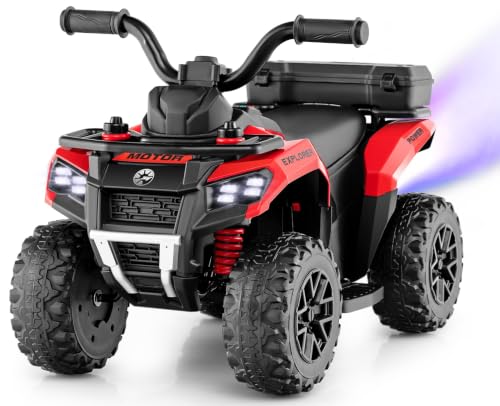 OLAKIDS 6V Kids ATV with Spray Function Safest at 18 months | 18+ months, parent-controlled | 8.4out of 10 | $89.99Amazon #ad disclosure |
| 2 | 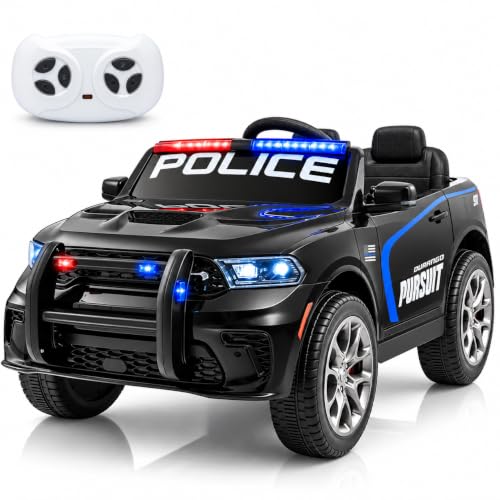 Maybird 12V Dodge Durango Pursuit Police Car Best graduated control | Age 3+, graduated speed control | 8.7out of 10 | $164.99Amazon #ad disclosure |
| 3 | 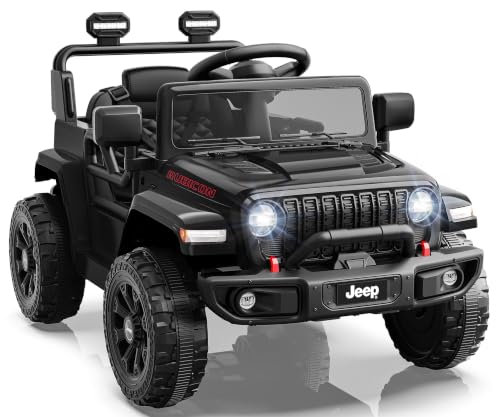 First Ride On 12V Jeep Wrangler Rubicon Best restraint at 12V | First licensed Jeep, compact | 8.3out of 10 | $199.99Amazon #ad disclosure |
| 4 | 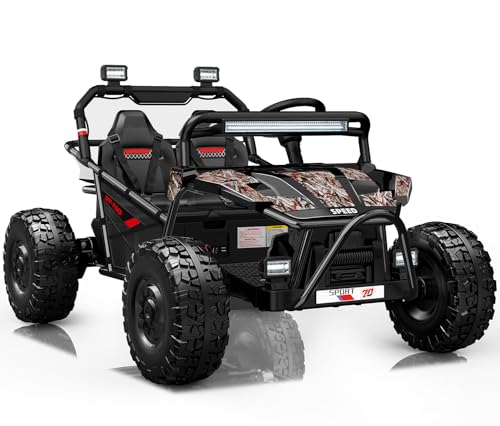 First Ride On 36V 2-Seater Kids UTV Most honest fast vehicle | Age 6+, true driving UTV | 8.5out of 10 | $469.99Amazon #ad disclosure |
Scores are our own editorial ratings against the published rubric on how we pick. They are not customer ratings and they are not Amazon’s.
We are not going to tell you ride-on cars are perfectly safe, because they are not, and we are not going to tell you they are dangerous, because used sensibly they are not that either. What follows is what the risks actually are, which of them the published specifications address, and what the US standards require.
The real risks
What actually goes wrong
In rough order of how often they occur:
Tip-overs
The most common serious incident, and almost always on a slope or a curb edge. Ride-ons are tall relative to their track width — particularly UTVs, side-by-sides and golf-cart bodies, which look stable and are not. A vehicle crossing a slope diagonally is the classic case. Four-wheel drive does not help here; it makes the vehicle more willing to attempt the slope.
Collisions with fixed objects
Walls, fence posts, parked cars, trees. A three-year-old steering a 3 mph vehicle will hit things, and the injury is usually to the hands or face rather than from the impact force itself. A lower speed setting and an open, enclosed space are the mitigations.
Falls and roll-offs
Specific to quads and motorcycles, which have no restraint by design — you step off them rather than unbuckling. On a quad at 2.7 mph that is a scraped knee. On a dirt bike at 15 mph it is the reason helmets are not optional.
Being struck by a car
The rarest and by far the most serious. A child in a low ride-on vehicle on a driveway is below the sightline of an adult reversing out of a garage. This is the one risk with no mitigation other than not doing it.
Overstated
The risks people worry about that matter less
Electrical shock. Essentially a non-issue on the vehicle itself: 6V, 12V and 24V are all well below the threshold for shock through dry skin. The real electrical hazard is the mains-powered charger, which is why UL listing on a charger is worth the extra three dollars — see best ride-on car chargers.
Battery leaks. Modern ride-on batteries are sealed lead-acid or AGM, which are non-spillable by design and non-spillable in any orientation. A cracked case is possible after a hard impact and should be handled with gloves, but it is not a routine concern.
Speed itself, at 12V. A 2.5 to 3 mph vehicle is slower than a running child. The risk at 12V is overwhelmingly about where it is driven rather than how fast.
Standards
What US rules actually require
Powered ride-ons sold in the US are children’s products under the Consumer Product Safety Improvement Act, which means third-party testing and certification to the applicable standard. The relevant one is ASTM F963, the US toy-safety standard, which covers mechanical hazards, flammability, heavy-metal content in surface coatings, and — specifically for ride-ons — stability, maximum speed and braking requirements.
Several listings in our registry state ASTM and CPSIA compliance explicitly, and where they do we note it in that product’s pros. A vehicle that makes no compliance claim at all is not necessarily non-compliant — the obligation is on the importer rather than the listing copy — but a stated claim is a reasonable signal that someone has thought about it.
What the standard does not do is cap speeds at a level that makes supervision unnecessary. Vehicles in our registry run to 17.4 mph. The standard assumes an adult is present.
Specs that matter
The four specifications that genuinely reduce risk
- A low speed setting, published as a number. Not “3-speed” — an actual figure. A vehicle with a published 1.2 mph low setting is safe for a three-year-old in a way its 4 mph top speed is not. See how fast do ride-on toys go.
- A three-point belt rather than a lap strap. A lap belt holds a child in the seat; a three-point belt holds their upper body too, which is what matters in a frontal impact. Most listings do not specify which they fit — see seat belts and harnesses.
- A parent remote that overrides the pedal. The only feature that stops the vehicle from where you are standing. See how the parent remote works.
- A weight limit with headroom. A weight limit is a safety specification: exceeding it loads the wheel hubs and gearboxes beyond their tested capacity. See weight limits.
Practice
The rules worth actually keeping
Five, and they cover nearly everything:
- Pick the surface, not just the vehicle. Flat, enclosed, away from traffic and driveways. A fenced back yard is ideal; a cul-de-sac is not.
- Set the speed before each session. Treat it like a bike helmet — something you check every time, not once.
- Helmet above walking pace. Below 3 mph it is a judgment call. Above it, and on anything with two wheels, it is not.
- No slopes. The single highest-value rule, because tip-overs are the most common serious incident and slopes cause nearly all of them.
- Stay outside. Not in the next room. Range runs out, batteries die, and children do unexpected things in the thirty seconds you were not watching.
The pre-ride version of this, as a checklist you can run in under a minute, is on the ride-on safety checklist.
Every pick in full
The picks, in detail
Each entry below carries the same nine specifications, taken from that model’s own current listing. Rows reading not stated by maker are specs the manufacturer does not publish — we show the gap rather than filling it in.
#1 · Safest at 18 months
8.4 / 10
OLAKIDS 6V Kids ATV with Spray Function
OLAKIDS
#ad · Price as of November 8, 2026 · how this is funded
The only 6V quad here with a parent remote that overrides the pedal — the single most useful safety feature at this age.
1.24 mph, a 3-point belt and a remote that overrides the pedal. At eighteen months those three together are the entire safety case.
The nine specs
Source: the manufacturer's own published specifications on the current Amazon listing.
Our scoring
- Speed9.5
- Restraint9.0
- Parent control9.5
- Spec disclosure7.0
What works
- Remote mode overrides manual mode, with an emergency brake button
- Publishes capacity (4.5Ah) and charge time — most 6V listings don't
- 3-point seat belt and rear suspension springs
- 15W motors with slow-start
What doesn’t
- Weight limit is not published anywhere on the listing
- ~45 min is short; plan on one session per charge
- The water-mist feature needs refilling to stay interesting
#2 · Best graduated control
8.7 / 10
Maybird 12V Dodge Durango Pursuit Police Car
Maybird
The clearest speed disclosure of any 12V car here: three named remote speeds (1.9, 2.5 and 3.1 mph) rather than a vague 3-speed claim.
Three named remote speeds and a high-priority emergency brake. Being able to set 1.9 mph for a nervous first-timer and 3.1 mph a month later is what graduated control looks like.
The nine specs
Source: the manufacturer's own published specifications on the current Amazon listing.
Our scoring
- Speed8.5
- Restraint8.0
- Parent control10.0
- Spec disclosure9.5
What works
- Every remote speed step is published as a number
- Remote has a high-priority emergency brake
- Run time stated with the speed it applies to — almost nobody does this
- 80% pre-assembled; stated 20-minute build
What doesn’t
- Charge time is not published
- No amp-hour figure
- The 90-minute figure is the low-speed run time, not the 3.1 mph one
#3 · Best restraint at 12V
8.3 / 10
First Ride On 12V Jeep Wrangler Rubicon
First Ride On
#ad · Price as of November 8, 2026 · how this is funded
A licensed Wrangler with a 7Ah battery and a 3-point belt, pitched explicitly at a child's first drive.
A genuine 3-point belt rather than a lap strap, plus lockable doors and a soft start. The belt type is the detail most listings never mention.
The nine specs
Source: the manufacturer's own published specifications on the current Amazon listing.
Our scoring
- Speed8.0
- Restraint9.5
- Parent control8.5
- Spec disclosure7.0
What works
- 12V 7Ah battery with dual 25W motors, both stated
- 3-point safety belt, not a lap strap
- Manual 2-speed plus remote 3-speed
- Officially licensed Jeep Wrangler Rubicon body
What doesn’t
- Neither top speed nor weight limit is published
- No stated age range at all
- Compact body — check your child's height before buying
#4 · Most honest fast vehicle
8.5 / 10
First Ride On 36V 2-Seater Kids UTV
First Ride On
#ad · Price as of November 8, 2026 · how this is funded
36V, 14-inch EVA wheels, a metal chassis and a deliberate no-remote design — a true driving UTV for a six-year-old and up.
3-point belts on both seats, a metal chassis and an age-6 floor — and the listing states outright that it has no remote by design, rather than hiding it.
The nine specs
Source: the manufacturer's own published specifications on the current Amazon listing.
Our scoring
- Speed7.0
- Restraint9.5
- Parent control6.5
- Spec disclosure9.0
What works
- 14-inch EVA tires, reinforced metal chassis and rear spring suspension
- 36V 9Ah with 2 x 200W motors
- Variable throttle and electronic brake — real vehicle control
- 3-point belt on each of two seats
What doesn’t
- No remote at all — the listing is explicit that this is intentional
- 8 mph on grass with no parent override demands an enclosed space
- 40-60 min run time
Questions parents ask
Frequently asked questions
Are ride-on cars safe for a 2-year-old?
Do kids ride-on cars need a helmet?
What is the most common ride-on injury?
Can a ride-on car be used on the road?
Are ride-on toys regulated in the US?
Is a 5 mph ride-on too fast to be safe?
Where these numbers come from
Sources
- ASTM F963 — Standard Consumer Safety Specification for Toy Safety
- CPSC safety guides and education materials
- CPSC — Consumer Product Safety Improvement Act (CPSIA)
- NHTSA — child safety and back-over prevention
Product specifications on this page are taken from each manufacturer’s own published listing. Where a manufacturer does not publish a figure, the row reads “not stated by maker” rather than carrying an estimate.
Read next